Actuary Hourly Pay in St. Paul, MN: $61.87 (2026)
Quick Answer:Hourly pay for a actuary working in St. Paul, MN runs $61.87 at the median for 2026 — annualizing to $128,685 at a standard 2,080-hour year. Figures projected from BLS OEWS 2025 (SOC 15-2011). Weighted against St. Paul's regional price level (BEA RPP 98.5, 1% below national), each hour of work buys what $62.81 nationally would. A 24-hour part-time schedule grosses $77,212 per year.
Based on BLS state-level estimates · View source
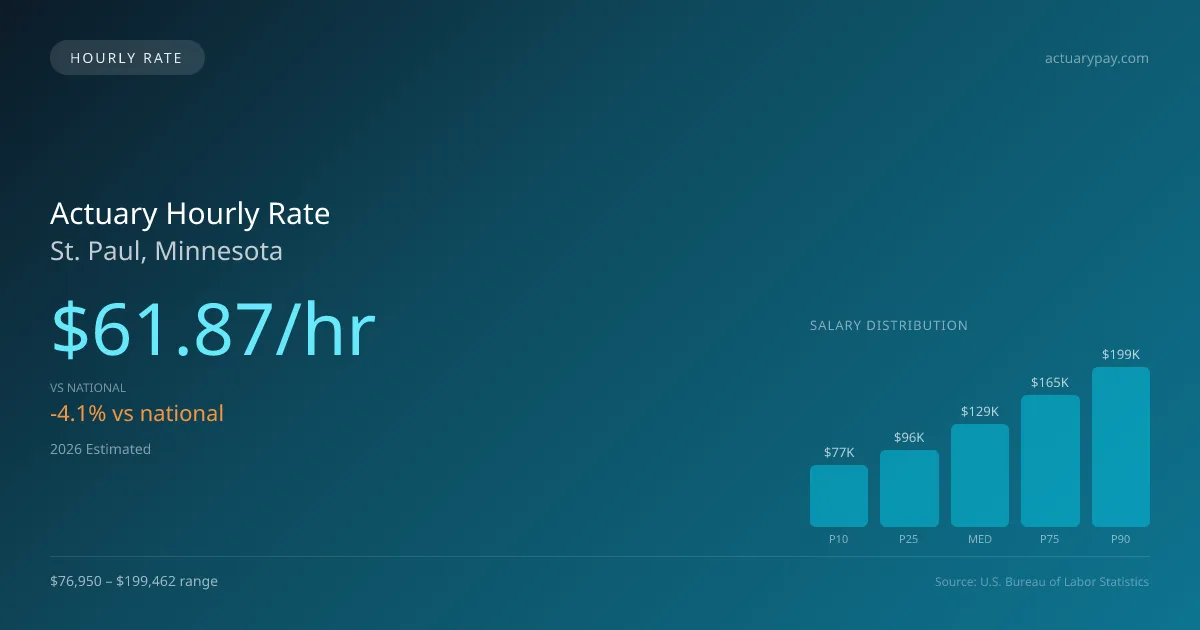
In St. Paul, Minnesota, the median hourly pay for actuaries is projected to be $61.87 in 2026, which is slightly below the national median of $64.50. This hourly rate is indicative of a profession that often operates within various settings such as insurance companies, consulting firms, and pension planning meetings. For actuaries working part-time, especially three days a week, this means the potential to earn a stable income while maintaining flexibility. The hourly pay scale in St. Paul ranges from approximately $37.00 for entry-level positions to about $95.89 for top earners, allowing for a diverse career path in this field. It's important to recognize that these hourly rates are derived from annual salary estimates, and actual earnings can vary based on experience, employer, and specific job functions.
About the St. Paul Market
Salary estimated from Minnesota average ($128,000) adjusted for local cost of living.
Actuary Hourly Wage Breakdown
| Percentile | Hourly Rate | Per 8hr Shift |
|---|---|---|
| Entry Level (P10) | $37.00 | $295.98 |
| Lower Range (P25) | $46.16 | $369.29 |
| Median (P50) | $61.87 | $494.95 |
| Upper Range (P75) | $79.20 | $633.57 |
| Top Earners (P90) | $95.89 | $767.15 |
Estimated Annual Income by Work Schedule in St. Paul
Based on $61.87/hr median hourly rate · 2026 est.
At $61.87/hr, a actuary working full-time (40 hr/wk) in St. Paul, MN can expect to earn approximately $128,686 per year (2026 est.). Part-time hygienists working 24 hours per week would earn around $74,242. With a cost-of-living index of 98.50 (below the national average), these earnings stretch further in St. Paul.
Hourly Rate Calculator
Schedule Comparison in St. Paul
| Schedule | Weekly | Monthly | Annual |
|---|---|---|---|
| Full-Time (40 hrs) | $2,474.74 | $10,724 | $128,686 |
| Part-Time (24 hrs) | $1,484.84 | $6,434 | $77,212 |
| Per Diem (16 hrs) | $989.89 | $4,290 | $51,475 |
Compare ASA, FSA Wages With Similar Roles
| Role | Median Hourly |
|---|---|
| Actuary (St. Paul) | $61.87 |
| Statistician (National Avg) | $51.53 |
| Mathematician (National Avg) | $56.16 |
| Financial Analyst (National Avg) | $47.61 |
| Data Scientist (National Avg) | $54.40 |
Actuarys in St. Paul, MN earn a median of $128,685 per year (2026 est.), which is 4.08% lower than the national median of $134,160 and 2.60% below the Minnesota state average of $132,120.
Actuary Hourly Pay vs. Cost of Living
Working 24h/week at $61.87/hr = $77,212/year (purchasing power: $78,388).
Working 40h/week (full-time) = $128,686/year (purchasing power: $130,646).
CoL index: 98.5 (100 = national average). Your dollars stretch further here.
2019 BLS Actual
$49.97/hr
2025 BLS Actual
$59.95/hr
2026 Current Est.
$61.87/hr
2019–2027 Growth
+27.8%
Hourly Rate Trajectory for Actuaries in St. Paul (2019–2027)
2019–2025: actual BLS OEWS data for this metro area. 2026+: CAGR 3.20% projection.
| Year | Hourly Rate | Status |
|---|---|---|
| 2019 | $49.97/hr | Actual |
| 2020 | $51.20/hr | Actual |
| 2021 | $48.84/hr | Actual |
| 2022 | $52.57/hr | Actual |
| 2023 | $55.34/hr | Actual |
| 2024 | $63.01/hr | Actual |
| 2025 | $59.95/hr | Actual |
| 2026(current) | $61.87/hr | Estimated |
| 2027 | $63.85/hr | Projected |
Based on 7 years of BLS OEWS metropolitan area data, the median hourly rate for actuaries in St. Paul grew 20.0% from $49.97/hr (2019) to $59.95/hr (2025). At a 3.20% projected growth rate, hourly pay is expected to reach $63.85/hr by 2027. Part-time and per-diem actuaries can use this multi-year trend to benchmark future contract negotiations.
Note: Historical values (2019–2025) are actual BLS OEWS figures for the St. Paul metropolitan area, sourced from annual Occupational Employment and Wage Statistics surveys. 2026–2026 figures are current estimates, and 2027 values are projections, calculated using a 3.20% CAGR derived from 7-year BLS historical data. Actual salaries may vary based on employer, experience, certifications, and local market conditions.
Working as an Hourly Actuary in St. Paul
Examining the financial dynamics of actuary roles in St. Paul reveals a lucrative pathway for part-time professionals. An actuary working a 24-hour week could expect to earn around $76,800 annually, which allows for a balanced work-life scenario, in stark contrast to full-time earners who make substantially more. Although agency or locum roles are uncommon for less experienced actuaries, those holding FSA or FCAS credentials can command impressive per diem rates ranging from $250 to $500 per hour for consulting. Additionally, expert witness fees can escalate to $800 per hour particularly in litigation scenarios. Hourly rates can vary significantly across employer types; life and health insurance companies tend to pay less than consulting firms like Milliman or Mercer, which offer premium compensation for FSAs and specialized skills in predictive analytics. While some might accept lower hourly rates for the added benefits that come with corporate positions, the trade-off in potential earnings should be considered, especially in a climate where effective negotiation can yield better outcomes for hourly workers in St. Paul.
More salary data for St. Paul, MN:
Frequently Asked Questions
What is the hourly rate for actuaries in St. Paul in 2026?
How much do part-time actuaries make in St. Paul?
Are actuaries in St. Paul paid hourly or salary?
How much does a full-time actuary make per year in St. Paul?
Do actuaries earn more per hour working part-time in St. Paul?
Related Pages
Compare Salaries
Career Resources
Nearby Cities in Minnesota
Written by Maria Chen, FSA, MAAA
Career Analyst
Maria has 10 years of experience in life insurance. She specializes in risk assessment and pricing strategies.
Methodology & Data Source
Hourly wage figures on this page are 2026 projections based on the Bureau of Labor Statistics Occupational Employment and Wage Statistics (OEWS) survey, May 2026 release. A 3.20% compound annual growth rate (CAGR), derived from 6-year national BLS wage trends, was applied to estimate current 2026 hourly rates for actuaries in St. Paul. Part-time and full-time income estimates assume consistent weekly hours and do not account for overtime, benefits, or seasonal variation.
Data Sources & Methodology
Salary data for St. Paul is estimated from official BLS state-level occupational wage data (2025), adjusted for regional cost-of-living differences using BEA RPP (Regional Price Parities).
2026 figures are projected from 2025 BLS data using a compound annual growth rate (CAGR) of 3.20%, derived from historical BLS wage trends for actuarys (SOC 15-2011).
Compiled and verified by Maria Chen, FSA, MAAA, a licensed actuary with 10+ years of clinical experience. · View source data at BLS.gov